How to Use a Concrete Base Calculator?
A concrete base may look simple on a drawing, yet small measurement errors can create expensive problems on site. A reliable concrete base calculator helps estimate the required volume from length, width, and depth. It can also include a practical waste allowance for uneven ground, spillage, and formwork imperfections. This matters because the Global Cement and Concrete Association reports that the world produces approximately 14 billion cubic metres of concrete each year. Even a small percentage error becomes significant across large projects.
The calculator is a planning tool, not a structural approval. A contractor may enter a 3-metre by 3-metre base with a 150-millimetre depth, then compare the result with ready-mix truck capacity or bagged concrete yield. However, the final design should reflect soil conditions, drainage, reinforcement, frost exposure, and expected loads. ACI 318 provides requirements for structural concrete, while ACI 211.1 guides concrete mixture proportioning. ASTM C94 also addresses ready-mixed concrete requirements. These references add professional context to a basic estimate.
Do not trust one number blindly.
Real sites are rarely perfect. Excavated edges may collapse, and subgrade levels may vary by several centimetres. A concrete base calculator cannot inspect those conditions. It also cannot replace local building requirements, an engineer’s review, or the supplier’s technical data. Used carefully, it reduces guesswork, improves ordering accuracy, and makes the estimating process easier to check. Still, the user should question every input, especially depth, waste percentage, and unit conversion. That small pause can prevent a costly shortage.
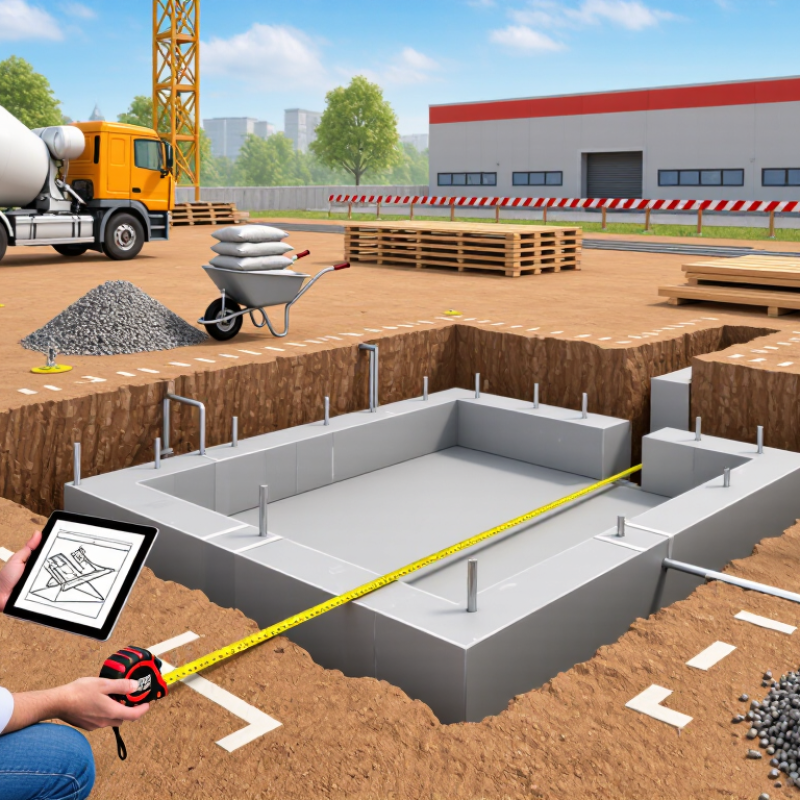
Identify the Concrete Base Measurements You Need
Before opening a concrete base calculator, identify every measurement the project requires. Start with the base footprint: measure its length and width in the same unit, such as metres or feet. For a rectangular base, record both dimensions carefully. Small errors can multiply across a large slab.
Depth matters more than many people expect. Measure the planned concrete thickness from the prepared surface, not from loose soil. If the ground slopes, take depth readings at several points and use the actual average. A straightedge and tape measure can reveal uneven areas that one quick measurement misses. It is easy to underestimate excavation depth.
For circular or irregular bases, record the diameter, radius, or separate sections. A post base may also need hole depth and diameter. Enter these values into the calculator, then check whether it asks for inches, centimetres, or another unit. Unit confusion creates expensive mistakes. The calculator usually estimates volume, but it cannot judge poor ground preparation or standing water. Add a modest allowance for spillage and uneven formwork, often around five to ten percent, according to site conditions. Do not treat that allowance as a substitute for accurate measurements.
Mark the measured edges on the ground before ordering concrete. Recheck the figures after installing forms, because forms can shift during preparation. I have found that a second measurement often exposes a missing centimetre or an overlooked corner. That extra check feels slow. It is cheaper than discovering a shortage during placement.
How to Use a Concrete Base Calculator? - Identify the Concrete Base Measurements You Need
| Measurement or Result |
What to Enter or Calculate |
Formula |
Example Value |
Why It Matters |
| Base Length |
The longest horizontal dimension of the concrete base. |
Measured directly |
2.40 m |
Defines the footprint and is used to calculate the base area. |
| Base Width |
The shorter horizontal dimension of the base. |
Measured directly |
1.80 m |
Works with the length to establish the total surface area. |
| Base Thickness |
The vertical depth of the concrete slab or footing. |
Measured directly |
0.15 m |
Determines the concrete volume; structural requirements may require a different thickness. |
| Number of Identical Bases |
How many bases have the same dimensions. |
Count the bases |
1 |
Allows the calculator to multiply the volume for repeated footings or pads. |
| Base Area |
The top surface area of one rectangular base. |
Length × Width |
2.40 × 1.80 = 4.32 m² |
Useful for estimating surface coverage and checking the measured footprint. |
| Concrete Volume per Base |
The amount of concrete required for one rectangular base. |
Length × Width × Thickness |
2.40 × 1.80 × 0.15 = 0.648 m³ |
This is the primary quantity produced by a concrete base calculator. |
| Total Concrete Volume |
Volume for all identical bases. |
Volume per base × Number of bases |
0.648 × 1 = 0.648 m³ |
Use this quantity when requesting ready-mix concrete or comparing bagged concrete requirements. |
| Waste Allowance |
An additional percentage for spillage, uneven excavation, and formwork variation. |
Total volume × (1 + Allowance %) |
0.648 × 1.10 = 0.713 m³ at 10% |
A modest allowance helps reduce the risk of running short; the correct percentage depends on site conditions. |
| Volume in Litres |
Metric conversion of the calculated concrete volume. |
Cubic metres × 1,000 |
0.648 × 1,000 = 648 L |
Provides a familiar reference for small-volume mixing and container capacity. |
| Volume in Cubic Yards |
Imperial conversion of the calculated concrete volume. |
Cubic metres × 1.30795 |
0.648 × 1.30795 ≈ 0.85 yd³ |
Useful when suppliers quote concrete in cubic yards rather than cubic metres. |
| Unit Consistency Check |
Confirm that length, width, and thickness use the same unit before calculating. |
Convert all inputs to m or ft |
150 mm = 0.15 m |
Mixing millimetres, metres, and feet without conversion produces an incorrect result. |
| Shape Check |
Identify whether the base is rectangular, circular, triangular, or irregular. |
Use the matching geometric formula |
Circular base: π × radius² × thickness |
The rectangular formula should not be used for non-rectangular bases without dividing the shape into simpler sections. |
Calculation example: For a rectangular base measuring 2.40 m × 1.80 m × 0.15 m, the required concrete volume is 0.648 m³. Adding a 10% allowance gives approximately 0.713 m³. Confirm the final dimensions, reinforcement, sub-base, drainage, and structural requirements with a qualified professional where applicable.
Choose the Correct Shape and Enter Its Dimensions
How to Use a Concrete Base Calculator?
Choose the Correct Shape and Enter Its Dimensions
A concrete base calculator is only as reliable as the shape and measurements you provide. Start by identifying the base design: rectangular, square, circular, or a combination of shapes. A rectangular pad needs length and width. A circular base needs its diameter. If the base is irregular, divide it into simpler sections and calculate each section separately.
Measure the excavation or formwork, not just the object it will support. Enter the base length, width, and concrete thickness in consistent units. Mixing metres and centimetres can create a serious volume error. For example, a 2-metre-long base with a 0.15-metre thickness requires those exact units throughout the calculator. Check the result against a manual volume calculation: length × width × thickness. This second check is worth the effort.
Tips: Measure twice, then enter the smaller confirmed value only when the formwork is fixed. Add a modest allowance for spillage and uneven ground, but do not hide poor measurements behind extra material. I have seen small height differences change an order noticeably. That is easy to underestimate. For stepped or sloped bases, calculate each level independently and add the volumes. Always review local construction requirements and ask a qualified professional to verify structural dimensions when the base supports heavy loads. A calculator estimates quantity; it does not replace engineering judgment.
How to Use a Concrete Base Calculator? – Choose the Correct Shape and Enter Its Dimensions
Choose the base shape that matches your project, then enter its dimensions. The chart shows the calculated concrete volume for common base shapes using the standard geometric formulas.
Set the Required Base Depth and Quantity of Bases
A concrete base calculator becomes useful when depth matches the real load and ground conditions. Enter each base’s length, width, and required depth, then multiply by the number of bases. Use consistent units. For example, a 400 mm square base at 300 mm depth contains 0.048 cubic metres of concrete. Ten bases require 0.48 cubic metres before waste. Add about 5% to 10% for spillage, uneven excavation, and leftover concrete, as commonly recommended in ready-mixed concrete estimating guidance from the National Ready Mixed Concrete Association.
Depth needs more judgment than quantity. The calculator cannot identify weak soil, frost movement, groundwater, or structural loads. ACI 318-19 requires structural design decisions to consider the supported load and foundation conditions, while local building rules may set minimum footing dimensions or frost depths. A shallow base may look economical. It may also tilt after one wet season. That mistake is expensive.
Set the required base depth after checking the drawing, soil information, and local requirements. Then calculate the total volume and round upward to a practical order size. For multiple bases, keep dimensions identical where possible. It simplifies excavation and reduces errors. I would recheck the result manually, even when the calculator appears clear. Small input mistakes matter. Ten bases entered as eight can disrupt the entire pour. Include reinforcement, formwork, and access limits in the site review, because volume alone does not confirm a safe foundation.
Review the Calculator’s Volume and Material Estimate
How to Use a Concrete Base Calculator?
A concrete base calculator turns length, width, and depth into an estimated volume. Enter each measurement in the same unit, such as metres or feet. A mixed-unit entry can produce a convincing but incorrect result. The calculator’s volume estimate should match a simple manual check: length × width × depth. For a circular base, use its diameter and depth carefully. Small errors matter. A base only 50 millimetres deeper may require noticeably more concrete.
Review the material estimate, not just the final volume. Check whether the result is shown in cubic metres, cubic yards, or litres. Then compare it with the supplier’s stated yield per bag or truckload. Add a practical allowance, often around 5–10 percent, for uneven ground, spillage, and form movement. This allowance is not wasteful by default. It can prevent a short pour. Still, the percentage depends on site conditions. A neat, level form may need less, while rough excavation may need more. Calculator figures are estimates, not guarantees. I would remeasure the excavation before ordering, especially after rain or soil collapse.
Tips: Measure the finished form, not the planned drawing. Confirm the calculator’s unit settings. Round material quantities upward only after checking package sizes. Keep a written record of every dimension. Ask a qualified professional to review structural requirements, reinforcement, and soil conditions. A volume calculator cannot judge load-bearing safety. That limitation is easy to overlook.
Convert the Result into Concrete Bags or Ordered Volume
A concrete base calculator gives dimensions, not a shopping list. Convert its result carefully before ordering materials. For example, a base measuring 4 feet by 6 feet by 4 inches needs 8 cubic feet of concrete. Divide that volume by the yield printed on each bag. If one bag yields 0.60 cubic feet, the calculation requires 13.3 bags. Round up to 14 bags, not 13.
Bag yields vary by mix and package size. Read the technical data sheet, rather than trusting a generic online estimate. The American Concrete Institute’s ACI 301 specification stresses accurate batching, placement, and control of concrete quantities. ASTM C94 also requires ready-mixed concrete information on delivery documentation, including quantity and mixture details. These standards support a practical habit: match the calculator’s unit with the supplier’s unit before ordering.
For larger bases, convert cubic feet into cubic yards by dividing by 27. Add a small allowance for spillage, uneven ground, and forms that are not perfectly square. Many contractors allow about 5% to 10%, but the correct amount depends on site conditions. I still measure twice when the excavation looks irregular. It feels excessive. It is cheaper than stopping with a half-finished base. Keep the unrounded calculation, the bag yield, and the final order quantity written beside the project measurements.