Choosing the best readymix concrete cost in China requires more than comparing a supplier’s headline quotation. Prices vary by city, strength grade, delivery distance, order volume, and project timing. A C30 mix delivered to a high-rise site in Shanghai may cost differently from the same mix delivered to a rural project near Chengdu. Pumping, night delivery, admixtures, testing, and waiting time can also change the final invoice.
Recent industry data supports this caution. China’s National Bureau of Statistics reported continued weakness in cement production during 2024, reflecting slower construction demand and uneven regional activity. The China Concrete and Cement Products Association also highlights capacity adjustment, transportation efficiency, and quality management as major industry concerns. Globally, the Global Cement and Concrete Association identifies raw materials, energy, logistics, and low-carbon production as important cost factors. These reports do not provide one universal concrete price. They provide context.
The practical question is not simply, “What is the lowest quote?” It is, “What is included?” A reliable comparison should list cement content, aggregate type, slump, compressive strength, delivery radius, pump charges, taxes, testing, and on-site waiting rules. Buyers should request current quotations from at least three certified local suppliers. Check laboratory records and batch-tracking procedures. Small omissions matter. A cheap quote may exclude pumping or add fuel-related adjustments later. This guide examines regional pricing, specification choices, supplier credibility, and hidden charges, helping buyers estimate readymix concrete cost with greater confidence. The method is useful, but not perfect. Local market checks remain essential.
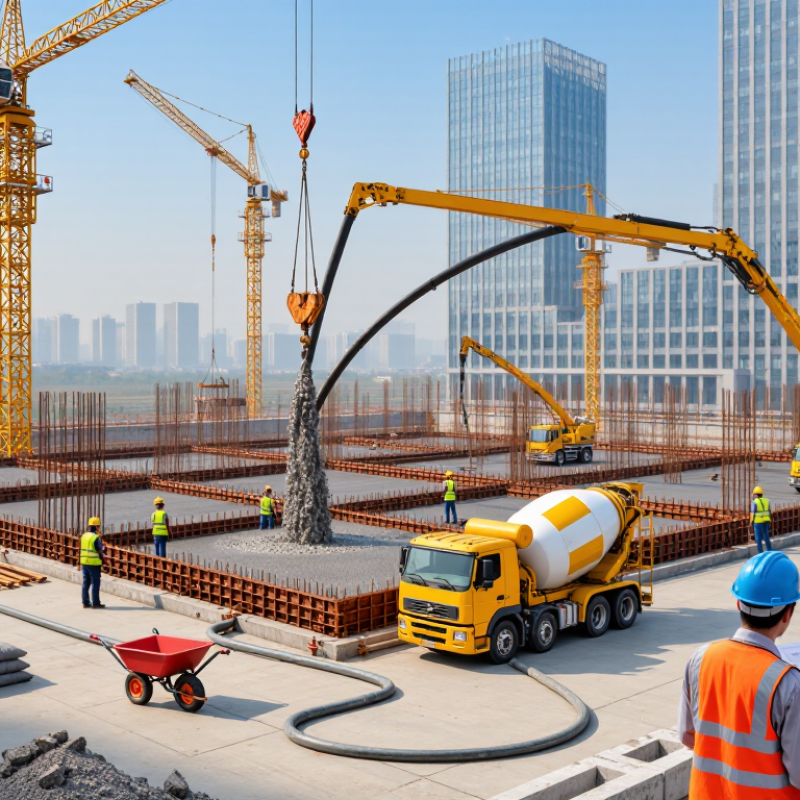
China has no single national price for ready-mix concrete. Regional quotations commonly range from RMB 300 to RMB 600 per cubic metre, before pumping and special additives. That estimate is imperfect. Urban projects near Shanghai, Guangzhou, or Beijing may pay more because land, labor, and delivery routes are expensive.
Material grade remains a major cost driver. Higher-strength concrete requires more cementitious materials and stricter quality control. The National Bureau of Statistics recorded about 2.02 billion tonnes of cement production in 2023, showing the market’s enormous scale, but not a uniform concrete price. Aggregates, cement, admixtures, and water content can change each quotation.
Transport distance is equally important. The China Federation of Logistics and Purchasing reported social logistics costs equal to 14.4% of GDP in 2023. Ready-mix concrete is time-sensitive, so long routes require extra trucks and tighter scheduling. Pump height, order volume, site access, waiting time, and night delivery also affect the final invoice. A small residential pour may carry higher unit costs than a large highway project. I would request a written quote with grade, slump, volume, pumping, delivery radius, and testing fees clearly separated. Many buyers overlook waiting charges. That mistake can be expensive.
| Cost Dimension | Typical Data or Range | How It Affects the Price | Practical Cost Considerations |
|---|---|---|---|
| Indicative Ready-Mix Concrete Price Ranges in China | |||
| East China | RMB 420–580 per m³ | Usually above the national average because of higher land, labor, energy, and urban logistics costs. | Large cities and congested construction zones may require additional delivery, waiting, or pumping charges. |
| South China | RMB 430–600 per m³ | Prices are influenced by strong construction demand, aggregate availability, and local transportation conditions. | Projects requiring high workability or extended setting time may be priced above the standard C30 range. |
| North China | RMB 380–520 per m³ | Costs vary according to seasonal demand, winter construction requirements, and raw-material transport distances. | Cold-weather concreting may require admixtures, heating measures, or additional quality-control procedures. |
| Central China | RMB 350–500 per m³ | Generally competitive due to relatively accessible cement and aggregate supply chains. | Long-distance delivery to smaller cities or rural projects can reduce the regional price advantage. |
| Southwest China | RMB 380–540 per m³ | Mountainous terrain, longer routes, and difficult site access can increase transport costs. | Confirm truck access, unloading space, and maximum allowable delivery distance before placing an order. |
| Northeast China | RMB 360–500 per m³ | Seasonal temperature changes and shorter construction periods can affect demand and production costs. | Winter projects may require thermal protection, accelerating admixtures, or other temperature-control measures. |
| Northwest China | RMB 360–520 per m³ | Prices are strongly affected by aggregate availability, project remoteness, and fuel-related logistics costs. | Remote or infrastructure projects should request a separate quotation for transportation and site services. |
| Main Product and Project Factors | |||
| Concrete Strength Grade | C20–C25: RMB 330–480/m³ C30: RMB 360–550/m³ C35–C40: RMB 400–650/m³ |
Higher strength generally requires more cementitious material, lower water-to-binder ratios, and additional admixtures. | C30 is a common benchmark for structural work, but the correct grade must follow the design documents and applicable standards. |
| Special Concrete Type | Ordinary concrete: baseline Self-compacting concrete: typically 10%–30% higher Fiber-reinforced concrete: typically 15%–40% higher |
Special formulations require additional materials, laboratory testing, production control, and quality assurance. | Specify slump flow, fiber type, durability class, permeability, and other performance requirements in the purchase order. |
| Slump and Workability | Common slump: 100–180 mm High-workability mixes may add approximately RMB 15–50/m³ |
Higher workability may require chemical admixtures or a redesigned mix proportion. | Do not add water at the job site without approval because it can reduce strength and durability. |
| Aggregate Size | Common nominal maximum sizes: 5–25 mm | Smaller or specially graded aggregates can cost more because of processing, screening, and supply limitations. | Aggregate size should match reinforcement spacing, member dimensions, pumping requirements, and the approved mix design. |
| Admixtures and Performance Requirements | Typical addition: RMB 10–60/m³ Special durability or setting-control requirements may add more. |
Water reducers, retarders, accelerators, waterproofing agents, and air-entraining agents increase material and testing costs. | Clearly define setting time, chloride limits, frost resistance, impermeability, and other performance criteria. |
| Delivery, Pumping, and Quantity Factors | |||
| Transport Distance | Short urban delivery: often included or separately quoted Long-distance delivery: commonly adds about RMB 5–15 per m³ for each additional 10 km, depending on local conditions |
Fuel, driver time, traffic, road conditions, and the need for additional trucks increase the delivered cost. | Confirm whether the quotation is plant-gate, delivered-to-site, or fully installed. Check the assumed one-way distance. |
| Pumping Service | Approximately RMB 20–60 per m³ for ordinary pumping arrangements Small-volume or difficult-access work may be charged by equipment or shift. |
Pump type, vertical height, horizontal distance, pipeline length, and site setup affect the final cost. | Separate the concrete material price from pump rental, labor, pipeline installation, and standby charges. |
| Order Quantity | Full truckload: commonly about 7–10 m³ Small orders may carry minimum-load or part-load charges. |
Small quantities do not fully utilize mixer trucks and production equipment, raising the unit price. | Combine compatible pours where possible and verify the supplier’s minimum order quantity. |
| Waiting and Unloading Time | Many quotations allow a limited unloading period; additional waiting is usually charged by time or truck. | Traffic, site readiness, crane interference, or slow placement can create standby costs. | Prepare access roads, workers, pumps, lighting, and inspection arrangements before the first truck arrives. |
| Construction Schedule | Night, weekend, holiday, or urgent delivery may add approximately 5%–20%. | Additional labor, dispatching, traffic restrictions, and production coordination increase operating costs. | Book high-volume pours several days in advance, especially during peak construction seasons. |
| Commercial and Quality-Control Factors | |||
| Quotation Basis | Plant-gate, delivered, pumped, or fully installed pricing | The same concrete may appear inexpensive if transport, pumping, testing, or tax-related items are excluded. | Request an itemized quotation showing concrete, delivery, pumping, testing, waiting, minimum-load, and other charges. |
| Quality Testing | Routine sampling and compressive-strength testing are normally required for structural concrete. | Additional testing for impermeability, chloride content, frost resistance, shrinkage, or special durability adds cost. | Testing frequency and acceptance criteria should be agreed before production and recorded in the quality plan. |
| Standards and Compliance | Common references include GB/T 14902 for ready-mixed concrete and GB 50107 for concrete strength inspection. | Compliance requires approved mix designs, production records, delivery tickets, sampling, and traceability. | Confirm the project’s applicable Chinese standards, design requirements, and local inspection procedures. |
| Payment Terms and Contract Volume | Large, scheduled projects may obtain better unit rates than irregular small orders. | Forecast accuracy, payment timing, contract duration, and guaranteed volume influence supplier risk and pricing. | Use a clear adjustment mechanism for cement, aggregate, fuel, and transportation fluctuations in long-term contracts. |
| Seasonal and Market Conditions | Prices may vary by approximately 5%–20% between low-demand and peak-demand periods. | Cement prices, aggregate supply, fuel costs, weather, infrastructure activity, and local construction demand all affect market pricing. | Compare several current local quotations using the same grade, slump, delivery distance, quantity, and service scope. |
| Indicative planning figures only: actual ready-mix concrete prices in China vary by city, project location, specifications, quantity, delivery distance, tax treatment, season, and supplier capacity. Prices should be confirmed through a current itemized quotation for the specific project. | |||